
Aesthetics Content Hierarchy: Why Not All Content Is Created to Convert

If every post on your clinic’s Instagram is expected to attract a new audience, educate them, build trust and convince them to book, your content is being asked to do too much.
That pressure usually leads to one of two things. Either every caption becomes a sales pitch, or the clinic jumps from trend to trend hoping that more reach will eventually translate into more appointments. Neither creates a particularly strong content strategy.
The reality is that different types of content have different jobs. Some content introduces your clinic to people who have never heard of you. Some helps prospective patients understand their options. Some gives them the confidence to take the final step and enquire.
This is where the Aesthetics Content Hierarchy comes in.
The Aesthetics Content Hierarchy is a simple way to organise your clinic’s content according to the role it plays in the client journey. At the base are trends, which support visibility and awareness. In the middle is educational content, which develops trust. At the top is client proof, which gives people the confidence to act.
All three levels matter. The problem begins when a clinic expects one post—or one type of content—to do all three jobs at once.
What is the Aesthetics Content Hierarchy?
The Aesthetics Content Hierarchy is made up of three levels:
Trends create awareness. They help new people discover your clinic and allow your brand to participate in relevant conversations.
Educational content builds trust. It answers the questions prospective patients are already asking and demonstrates your knowledge, judgement and approach.
Client proof creates action. It reduces uncertainty by showing credible evidence of the experience and results your clinic delivers.
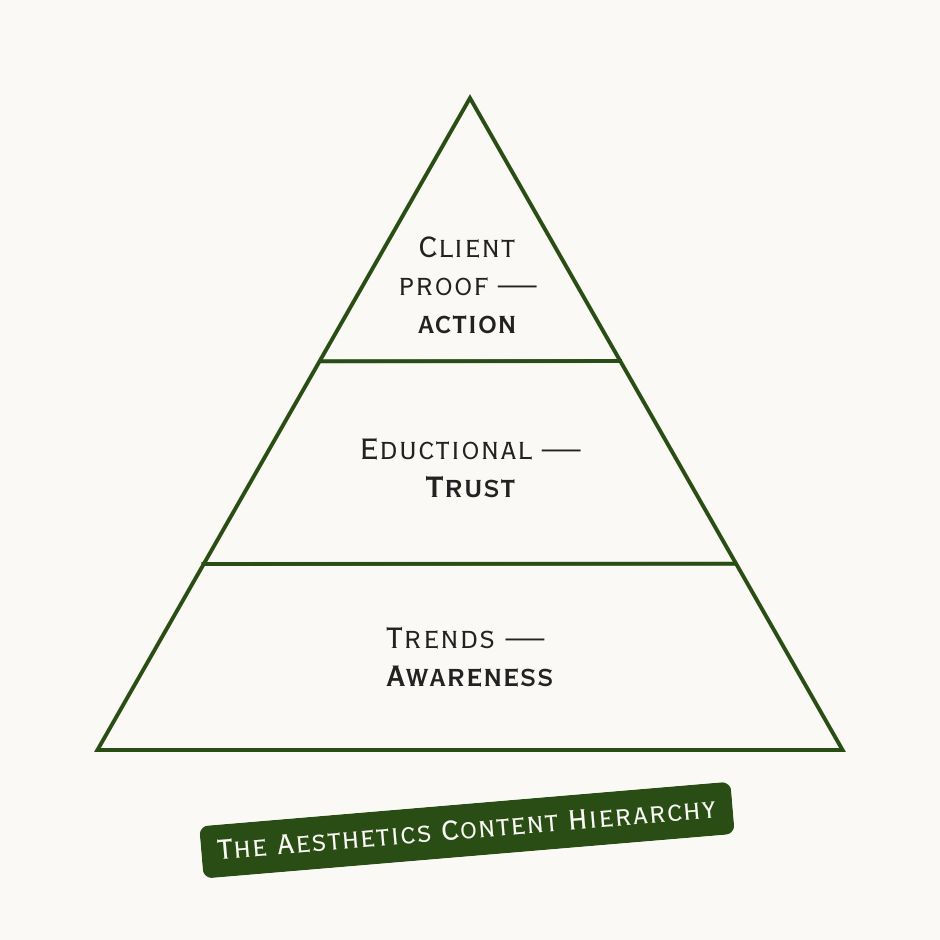
It is tempting to interpret this as a ranking in which client proof is “better” than educational or trend-led content. It is more useful to think of it as a journey. Each level prepares the audience for the next.
A person may first find you through a relatable Reel, return because a carousel clearly explains a concern they have been researching, and finally book after seeing a realistic result from a patient with a similar starting point. The booking cannot always be attributed to one post. It is the cumulative effect of the content around it.
This matters particularly in aesthetics. Prospective patients are not simply choosing a product; they are choosing a practitioner, a clinic and an outcome that can affect how they look and feel. Their decision depends on safety, expertise, expectations, rapport and trust. A single viral Reel is unlikely to communicate all of that.
Level one: trends create visibility
Trend-led content sits at the base of the Aesthetics Content Hierarchy because it is often the broadest entry point into your brand.
This might include a trending audio, a popular editing style, a timely conversation, a behind-the-scenes format or a culturally relevant joke adapted to clinic life.
Used well, trends can:
Expand your reach beyond existing followers
Make your clinic feel current and culturally aware
Show the personality of your team
Encourage shares, comments and conversation
Help local audiences remember your name
This content is useful. But visibility is not the same as conversion.
A Reel may receive thousands of views because it is entertaining or recognisable, while generating very few enquiries. That does not automatically mean it failed. If its intended purpose was discovery, reach and brand awareness are more appropriate measures of success than bookings.
The issue comes when clinics rely on trends as their entire strategy. A potential client might enjoy the content without learning why they should trust the clinic with their face, skin or body. They have seen you, but they have not yet been given enough information to choose you.
Trends can also become a distraction when they are adopted without considering brand fit. Not every audio needs to be used. Not every meme suits a medically led clinic. The strongest trend-led content still feels recognisable as your brand: it reflects your tone, your audience and the experience somebody can expect when they walk through your door.
Before using a trend, ask:
Does this make sense for our ideal client?
Can we connect it naturally to our expertise or clinic experience?
Does it show a useful or memorable side of our brand?
Will it still feel appropriate once the trend passes?
You do not need to stop following trends. You simply need to be clear about where they belong. Trends get you noticed; the rest of your content must give people a reason to stay.
Level two: educational content builds trust
Once somebody has discovered your clinic, their next questions are rarely limited to price or availability. They want to know whether a treatment is suitable for them, what it involves, what can realistically be achieved and whether you understand their concerns.
Educational content occupies the middle of the Aesthetics Content Hierarchy because it bridges the gap between awareness and action.
Strong educational content can:
Explain common concerns in accessible language
Introduce appropriate treatment options
Set realistic expectations around outcomes and timelines
Clarify preparation, aftercare and recovery
Correct misconceptions without creating fear
Show how your clinic assesses and treats patients
The aim is not to publish a digital textbook. It is to make the decision feel clearer and safer.
For example, a generic post titled “Three benefits of micro-needling” may share accurate information, but it is unlikely to distinguish your clinic. A stronger post might explain why you would not recommend micro-needling to every patient asking about acne scarring, what you assess during consultation, and how treatment plans can differ depending on whether scarring, pigmentation or active inflammation is the primary concern.
That content does more than define a treatment. It reveals your judgement.
This is important because prospective clients can find basic treatment information almost anywhere. What they cannot get from a generic search is your approach: how you make decisions, what you prioritise and how you care for the person behind the concern.
The best educational ideas often come directly from the clinic. Consider the questions asked in consultations, the misunderstandings your reception team hears, the expectations practitioners regularly need to reset and the aftercare concerns that appear in follow-up messages. Those are not repetitive questions to avoid; they are evidence of what your audience genuinely needs from you.
Educational content should also recognise that information alone does not automatically create trust. Tone matters. Overcomplicated terminology may demonstrate knowledge, but it can leave the reader feeling excluded. Overpromising may sound persuasive, but it creates expectations that responsible treatment cannot meet. Clear, calm and specific communication is usually far more powerful.
Useful formats include:
Carousels that break one question into manageable steps
Talking-head videos in which a practitioner explains their approach
Treatment comparisons focused on suitability rather than declaring a winner
Consultation-style posts built around a real concern
Myth-versus-reality content with meaningful context
FAQs based on actual enquiries
This level of the Aesthetics Content Hierarchy turns passive followers into informed potential clients. It gives them language for their concern and helps them imagine having a useful conversation with you.
Level three: client proof creates action
At the top of the hierarchy is client proof: the evidence that helps a prospective client move from “I am interested” to “I feel confident enough to enquire.”
Client proof can include:
Genuine testimonials
Client journeys documented over time
Realistic before-and-after images
Treatment progress and transformations
First-person descriptions of the clinic experience
Video reactions or reflections, shared with appropriate consent
This content works because it makes an otherwise abstract promise tangible. A clinic can say that it offers natural-looking results and thoughtful care, but a detailed client journey shows what those claims look like in practice.
The most effective proof is specific. “Amazing clinic, I love my results” is positive, but it gives the reader very little context. A testimonial explaining what the client was worried about, why they chose the clinic, how the practitioner made them feel and what changed afterwards is much more persuasive.
Before-and-after images also need context. What was the client’s concern? What treatment or combination of treatments was used? Over what period? How many sessions were involved? Were the photographs taken under consistent conditions? Is the result typical, and what variables could affect another patient’s outcome?
Adding this information makes the content more credible and more useful. It also avoids presenting aesthetics as a collection of instant, guaranteed transformations.
Client proof should show more than the finished result. For many people, the experience surrounding the treatment is just as important. They may be worried about feeling judged, looking overdone, experiencing pain or not being listened to. A client story that addresses those emotional barriers can create confidence in a way that a polished result image alone cannot.
Of course, proof must be handled responsibly. Obtain clear consent, protect patient dignity, avoid editing that misrepresents results and ensure claims comply with the advertising rules relevant to your treatments and location. Trust is difficult to build and very easy to weaken. Authentic, well-documented evidence will always serve the brand better than dramatic proof stripped of context.
Being seen is not the same as being chosen
One of the most important ideas within the Aesthetics Content Hierarchy is the distinction between reach and readiness.
Reach, views and awareness start the conversation. Choice depends on trust, proof and confidence.
This is why a clinic can have a large following but inconsistent bookings, while another with a smaller, highly relevant audience maintains a busy diary. Audience size is only one part of the picture. The content also needs to help the right people move forward.
If your posts are reaching new people but not generating profile visits, saves or meaningful engagement, the connection between the content and your clinic may be too weak. If people visit the profile but do not enquire, they may not be finding enough education, evidence or clarity. If enquiries arrive but do not convert, the next issue may sit beyond social media—in response times, consultation processes, pricing clarity or the overall client experience.
Content can support the booking journey, but it cannot compensate indefinitely for a broken one.
How to build a balanced aesthetics content strategy
A balanced strategy does not require an equal number of posts at every level. The right mix depends on your clinic’s goals, maturity, audience and existing reputation.
A newer clinic may need more awareness content to become known locally, supported immediately by strong educational posts and enough proof to establish credibility. An established clinic with good recognition but a new treatment launch may lean more heavily on education and relevant client journeys. A practitioner with high reach but low enquiry quality may need less broad trend content and more material that clearly communicates their specialism and ideal client.
Start with a simple audit of your latest 12 to 20 posts. Label each one:
Awareness: primarily designed to reach or entertain
Trust: primarily designed to explain, guide or demonstrate expertise
Action: primarily designed to prove, reassure or prompt the next step
Some posts will support more than one purpose, but identify the main job. Then look for gaps.
If almost everything sits at awareness level, followers may know the team’s personality without understanding its expertise. If everything is educational, the feed may be useful but struggle to reach new audiences or feel human. If almost every post is a before-and-after or sales message, the clinic may appear transactional and give people little reason to connect between booking decisions.
Next, connect the three levels around themes. If your monthly focus is adult acne, you might create:
A relatable, trend-led Reel about the frustration of receiving unsolicited skincare advice
An educational carousel explaining why adult acne treatment is not one-size-fits-all
A documented client journey showing how a personalised plan evolved over several months
Together, those posts create a far stronger campaign than three unrelated pieces of content. One earns attention, one develops understanding and one provides evidence.
Each post should also have a call to action that matches its place in the hierarchy. An awareness post might invite somebody to follow or share. An educational post might encourage them to save the advice or read a related blog. A proof-led post might invite them to book a consultation or send an enquiry. Asking every viewer to “book now” ignores how decisions are actually made.
Measure each level by the job it is meant to do
Content performance becomes easier to understand when success is measured against intent.
For trend and awareness content, look at non-follower reach, video views, shares, profile visits and local audience growth. For educational content, consider saves, meaningful comments, watch time, website clicks and the questions people ask afterwards. For client proof, look at enquiries, consultation bookings, conversion quality and whether new clients mention a testimonial or result they saw.
Do not judge every post against the same metric. A deeply useful carousel may reach fewer people than a trend but influence a more valuable decision. A testimonial may receive modest engagement while giving three prospective patients exactly the reassurance they need.
The most meaningful results also appear across a sequence, not necessarily within a single attribution window. Ask new clients how they found you, what content they viewed and what helped them decide. Those conversations often reveal more about the true value of your content than likes alone.
Use the Aesthetics Content Hierarchy as a planning tool
The Aesthetics Content Hierarchy is not another rigid formula or a reason to force your clinic into every trend. It is a lens for making more intentional decisions.
Before creating a post, ask: who is this for, what stage are they at, and what should this content help them think, feel or do next?
When every piece has a defined role, content planning becomes less reactive. You stop relying on whatever format is currently popular and begin building a body of content that supports the full client journey.
Trends help your clinic become visible. Education turns that attention into trust. Client proof builds the confidence to act.
You need all three—but you do not need every post to do everything.
If your clinic is posting consistently but the content is not translating into meaningful enquiries, the answer may not be to create more. It may be to understand what is missing from your Aesthetics Content Hierarchy and build a more purposeful route from discovery to decision.
Need help turning your clinic’s expertise, client experience and results into a clearer content strategy? Aesthetic Obsessed supports aesthetic clinics with creative strategy, content planning and campaigns designed around the way real clients make decisions. Book a discovery call now.


Comments